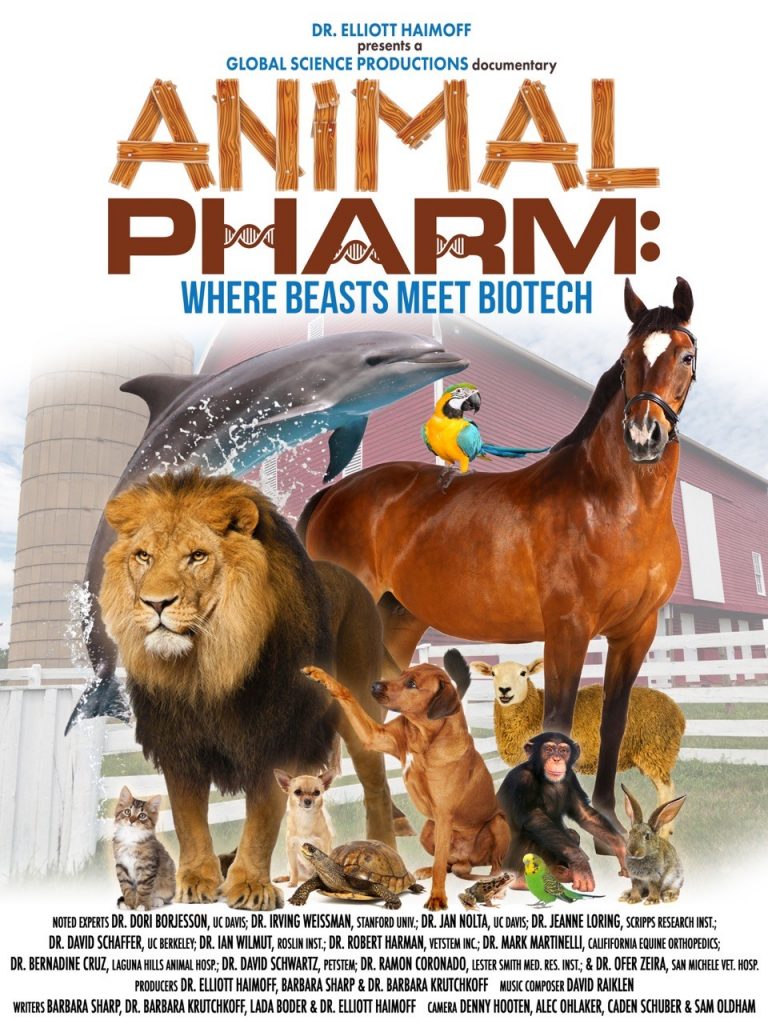
In our blog about translational
medicine, we announced that VetStem was featured in an award-winning
documentary, Animal
Pharm: Where Beasts Meet Biotech. The
film was included in the Brentwood and Pacific Palisades International
Film Festival in Los Angeles, California where it received the award for Best
Nature and Animals Film.
The documentary focuses on regenerative
veterinary medicine as a means of improving the quality of life for domestic
and wild animals and heavily features VetStem, including an interview with
VetStem Founder and CEO Dr. Bob Harman. Dr.
Harman explains that when he first conceived of and formed VetStem, he was
called “crazy.” Over time however the thinking has evolved so that regenerative
medicine is now regarded as a legitimate and valuable tool for veterinarians.
We recently received the exciting
news that the film will be featured in the Palm Beach
International Mini Movie and Film Festival on December 9th in Palm
Beach, Florida. Not only will the film
be featured, the producers will also be presented with the award for Best
Documentary! Congratulations to everyone
involved in the making of the film.
We are proud to be a part of
this film and believe that it provides a great service to the public by
providing legitimate education about cell therapy in the veterinary field and
how this can assist the field of human stem cell therapy.
A few weeks ago, our sales and marketing team was at the American
Association of Feline Practitioners conference in San Francisco, CA. So, we thought it an appropriate time to discuss
stem cell therapy for cats. This blog
will give you an overview of some of the conditions that veterinarians have treated
with VetStem Cell Therapy.
Veterinarians have used VetStem Cell Therapy to treat a variety of
conditions in their feline patients, one of which is osteoarthritis. Though we primarily think of dogs when it
comes to osteoarthritis, cats are not immune to the disease. Their symptoms however may be more subdued or
even unnoticeable to their owners- cats tend to be masters at hiding their
illnesses. Some signs to look out for
include a decreased activity level, an inability to jump to high places, and
missing the litterbox. In addition to
osteoarthritis, veterinarians have used VetStem Cell Therapy to treat cruciate
ligament injuries and fractures in cats.
Veterinarians also use VetStem Cell Therapy for the treatment of internal medicine and immune-mediated diseases in cats through our Clinical Research Programs. A large population of VetStem’s feline patients have been treated for Chronic Kidney Disease. Based upon data from a small number of feline patients treated with VetStem Cell Therapy, blood kidney values were slightly to moderately improved after treatment. The goal of our current clinical research program for feline Chronic Kidney Disease is to gather additional data and to better understand the effects of stem cell therapy on these cats.
Two additional clinical research programs are for the treatment of feline Gingivostomatitis and Inflammatory Bowel Disease. Gingivostomatitis is a painful disease that affects the mouth of cats and can lead to full mouth teeth extractions. Two small studies conducted at the University of California Davis in cats with full mouth teeth extractions showed favorable results after receiving stem cell therapy for this condition. VetStem believes that stem cells may help without cats having to undergo full mouth teeth extractions. Inflammatory Bowel Disease is a chronic gastrointestinal disorder which can cause diarrhea, vomiting, inappetence, and weight loss. In a recently published paper, 5 out of 7 IBD cats that were treated with stem cells were significantly improved or had complete resolution of symptoms whereas the 4 control cats had no improvement. Since this disease can also affect dogs, VetStem is evaluating the use of stem cells in both species with this condition.
Though this is not an all-inclusive list, the above conditions are those
that are most commonly treated in cats with VetStem Cell Therapy. As always, if
you think your cat may benefit from stem cells, speak to your veterinarian or contact us for a list of VetStem
providers in your area.
It is officially November, which happens to be Senior Pet Month! We wanted to highlight senior pets in this
week’s blog as we all know that senior pets may be more at risk of developing osteoarthritis. While dogs and cats of all ages may develop
osteoarthritis, studies have indicated that senior dogs are more often diagnosed
with osteoarthritis, in part due to the age-related break down of joint tissues
such as cartilage, ligaments, and bone.
There is also speculation that senior pets are more often diagnosed
with osteoarthritis because symptoms become more prevalent as the disease
worsens. Therefore, owners are more
likely to notice symptoms such as limping and stiffness as their pet ages,
which often leads to a trip to the veterinarian for diagnosis/treatment.
Maverick,
a Golden Retriever, was adopted at 8 years old with osteoarthritis. Fortunately, his new parents sought VetStem Cell
Therapy for his condition and he experienced an improved quality of life.
VetStem Cell Therapy Recipient Maverick
It is important to note however that dogs and cats may develop
osteoarthritis at any age. For instance,
if a dog is born with joint dysplasia (malformed joints), he is more likely to
develop osteoarthritis at a younger age than a dog born with properly formed
joints. One example is Jack
who was showing symptoms of osteoarthritis before he was even a year old.
VetStem Cell Therapy Recipient Jack
The good news is, VetStem Cell Therapy has shown to help pets, both young and old,
with osteoarthritis. Stem cells have
been demonstrated to regenerate joint tissues and reduce inflammation. They also have pain blocking
mechanisms that may lead to increased comfort for painful pets. If your pet, no matter their age, has been
diagnosed with osteoarthritis or is showing signs of the disease, speak to your
veterinarian about the possibility of treatment with VetStem Cell Therapy. Or contact
us to receive a list of VetStem providers in your area.
This week we’d like to introduce you to a longtime VetStem user, Dr.
Jerrold Bausman of VCA Veterinary
Specialists of the Valley. Dr.
Bausman received his DVM from Kansas State University after which he completed
a small animal surgical internship and residency at Animal Specialty
Group in Los Angeles. While Dr. Bausman’s
practice is focused on surgical cases, he frequently treats patients with osteoarthritis
using VetStem Cell Therapy. Dr. Bausman
has been utilizing VetStem Cell Therapy since 2007 and has provided VetStem services
for nearly 70 patients including our favorite 3-legged mini Aussie, Mandy. Another memorable patient was a cat named
Small, who was treated for a fracture and osteoarthritis. Small’s family came all the way from India to
receive VetStem Cell Therapy.
We recently asked Dr. Bausman a
few questions about VetStem Cell Therapy.
See his answers below.
What injuries/ailments
do you typically treat with VetStem Cell Therapy?
I primarily treat osteoarthritis. Next
in line to that would be tendinopathies including traumatic rupture, avulsion
or tendon laceration repairs. More specifically – I treat hip arthritis,
followed by elbows for OA then I’d say biceps or supraspinatus tendinopathies.
When
is a patient not a good candidate for stem cell therapy?
In my opinion a patient is not a good candidate
for stem cell therapy if they have an ailment that stem cells will not assist
in. Let me clarify with an example – cranial cruciate ligament tear.
I have some clients that think stem cell therapy will fix the CCL tear.
That patient is not a good candidate for CCL repair with stem cells.
That patient’s stifle will benefit from stem cells – but they are not
going to fix the torn ligament. Aside from that, it’s anesthetic
risk. I have some patients that are excellent candidates for stem cell
therapy BUT are such anesthetic/surgical risks that I do not recommend harvesting
(fat for stem cell therapy). In these cases, I would consider PRP.
You’ve
been providing VetStem services for over 10 years. Why is VetStem your
go-to stem cell provider?
VetStem is my go-to
stem cell provider because in over 10 years I have never had a single bad
experience with them. And that spans the gamut from quality of product,
product delivery and patient outcomes through quality of customer service.
You can always count on a friendly helpful person on the phone every time we
call. And lastly innovation. I love that VetStem is leading the way
in regenerative therapy.
Dr. Jerrold Bausman
We appreciate Dr. Bausman taking the time to speak with us about his
use of VetStem Cell Therapy. If you’re
looking for a VetStem provider in the Los Angeles area, contact VCA Veterinary
Specialists of the Valley for a consult.
Most pet owners know that having a pet comes with many bonuses. Pets provide companionship, entertainment,
and unconditional love. But did you know
that pets may have a positive effect on our ,mental and physical health as
well?
There have been several observational studies that have pointed to the
potential health benefits of owning a pet.
A recent review of nearly 70 years of global research concluded that owning
a dog may reduce your risk of death. Notably,
pet owners have demonstrated reduced blood pressure, lower triglyceride and cholesterol
levels, and therefore, reduced cardiovascular disease.
It has been observed that pet owners are less likely to suffer from
depression, loneliness, and anxiety.
While playing with a dog or cat can elevate levels of serotonin
and dopamine, one study found that simply watching cat videos can boost energy
and positive emotions while reducing negative feelings.
Dog ownership has also been linked to an increase in exercise for the
owner. Most dog owners take their dogs
for walks while some choose to run or hike with their canine companion. This also gets the owner outside and around
other dog owners where you may potentially make new friends.
While most studies have pointed to dogs and/or cats, other pets may
bring health benefits as well! For example,
watching a fish in an aquarium may help reduce muscle tension and lower your
pulse rate. Another example would include
horse owners who may get outside frequently to care for or ride their
horse(s). This type of structure and routine
can help to give you purpose while keeping you balanced and calm.
We agree that pets improve our lives in many ways and most of our employees
have at least one pet. Meet some of our employees’
pets below!
Seve is a senior Golden Retriever who, earlier this year, was diagnosed
with severe osteoarthritis in his hips.
His owners noticed that his back legs would go out from under him and he
seemed to be a little “gimpy.”
After the diagnosis, his veterinarian, Dr. Cindy Echevarria of VCA University Animal Hospital
recommended treatment with VetStem Cell Therapy. Seve initially received three stem cell
injections: one into each hip and one intravenously in January 2019.
Seve had a great response to his initial treatment and his mom was very
pleased. You can catch up on Seve’s
story here.
When we reached out to Seve’s mom in July, she reported that he was
showing symptoms of discomfort again.
His back legs became a bit less stable and started to go out from under
him again. Fortunately, Seve still had
several stem cell doses banked from his initial fat collection procedure. The doses Seve had banked were available for
treatment at the request of Dr. Echevarria.
In August of 2019, Seve received his second treatment utilizing his
banked stem cells. The same injection
protocol was followed: one in each hip and one intravenously. We recently spoke with Seve’s owner and once
again he had a great response to the therapy.
His owner reported that he’s feeling much better.
Osteoarthritis is a progressive disease, so Seve’s story is a good
example to point out that it is not uncommon for arthritic dogs to require additional
treatments to keep them feeling comfortable.
We emphasize that every patient is different in so many ways: from
severity of the disease being treated, to lifestyle, to how they handle and show
pain. Thus, it is impossible to predict
how each patient will respond and we think it is important that pet owners have
the proper expectations when it comes to stem cell therapy.
What we do know is that stem cells have been shown to reduce pain and inflammation,
and to regenerate joint tissues, all of which may improve the quality of life for
an arthritic dog like Seve. If you think
your pet may benefit from VetStem Cell Therapy, speak to your veterinarian or contact us to receive a list of
VetStem providers in your area.
We recently received news that one of VetStem’s most experienced users,
Dr.
Jeff Christiansen, treated an extra special patient with surgery and Platelet
Rich Plasma using a kit that was donated by VetStem. But what makes this patient so special, you
ask? Well, it was a Kangaroo!
Bunji is a 2-year-old Red Kangaroo who lives at the Brevard Zoo in
Melbourne, Florida. In July during the daily
morning check-in, his keepers found him injured and while it was clear he had
broken bones, there was no known cause of the injury. X-rays revealed he had fractured his radius
and ulna in his right forelimb and surgery was indicated to ensure proper healing.
X-ray of Bunji’s broken limb
Dr. Christiansen, a veterinary surgical specialist, was called in for
the job and performed the surgery on Bunji.
A plate was placed to hold the bones together. He also used Bunji’s own bone marrow to aid in
healing the fracture site. Lastly, he
treated Bunji with Platelet Rich Plasma utilizing the Genesis CS-2 kit, which
is typically used to treat horses.
First, Dr. Christiansen collected blood from Bunji, which he then centrifuged
to concentrate the platelets. Once the
platelets were concentrated and collected, he injected the platelet rich plasma
directly into Bunji’s surgical site. Platelets,
when exposed to damaged tissue, release signals to attract healing cells to
both speed up and increase the quality of healing.
Bunji spent approximately two months in recovery at the zoo animal clinic before he was returned to the Kangaroo Walkabout. He is reported to be doing well and seems happy to be reunited with his Kangaroo buddies. Though we have not done any work with a Kangaroo before, Bunji is not the first exotic animal that VetStem veterinarians have treated. In April, we reported that a Sun Bear at the San Diego Zoo received VetStem Cell Therapy for his arthritis.
As we close out Animal Pain Awareness Month, we wanted to leave you
with some information to help you determine if your pet may be experiencing
pain. Unfortunately, pets cannot talk to
us to let us know if there is a problem.
Thus, we must rely on other methods to decipher whether they are experiencing
any pain. One of the best methods to
determine if your pet is in pain is to observe their behavior.
As we discussed in a recent
blog, there are several causes of pain, both acute and chronic. Acute pain may be more obvious while chronic
pain may be more subtle. Often, chronic
pain is misconstrued as “getting old” but the International Veterinary Academy of
Pain Management (IVAPM) is quick to point out that age is not a disease. Pain however is a disease and pain management
is important to maintain your pet’s quality of life.
So how do you know if your pet is experiencing pain? Aside from the more obvious signs such as
limping, one of the best ways to determine whether your pet may be in pain is a
change in their behavior. This can include
an increase in anxiety, depression, or aggression as well as decreased social interaction
or play. Your pet may become less active
or have difficulty doing things that were not a problem before. For instance, they may have trouble getting
up from lying down or they may have difficulty jumping or going up and down
stairs.
Other changes may include decreased grooming, particularly for
cats. Some pets however over-groom areas
of pain and may lick or bite excessively at an area that hurts. They may also experience decreased appetite
as well as changes in their bathroom habits.
Changes in posture as well as increased respiration or excessive panting
can also be a sign of pain. You can view
an extensive list of
symptoms for both dogs and cats on the IVAPM website.
It is important to keep an eye out for signs that your pet may be in
pain. Pain management is an invaluable
tool in maintaining happy and healthy pets.
Last week, we introduced you to Veterinary Pain Specialist, Dr.
Douglas Stramel. While his practice
focuses primarily on pain management, all veterinarians are equipped to handle
painful pets in some capacity. Your veterinarian
may also be able to recommend a local pain specialist if you’re seeking a more
in-depth approach to pain management.
As always, if you think your pet may benefit from VetStem Cell Therapy,
speak to your veterinarian or contact
us to receive a list of VetStem providers in your area.
As we shared last week, September is proclaimed as Animal Pain Awareness Month by the International Veterinary Academy of Pain Management (IVAPM). Keeping with our theme of pain awareness, we would like to introduce you to veterinarian and Certified Veterinary Pain Practitioner, Dr. Douglas Stramel of Advanced Care Veterinary Services in Carrollton, Texas. Dr Stramel is the first and only Certified Veterinary Pain Practitioner in the Dallas/Fort Worth area and is also the President-Elect of IVAPM.
As
the President of IVAPM, Dr. Stramel takes pain management very seriously and
has made it a primary focus of his veterinary practice. He employs advanced multi-modal pain
management protocols including physical therapy, acupuncture, shock wave, laser
therapy, and, you guessed it, regenerative medicine.
Dr.
Stramel has been credentialed to perform VetStem Cell Therapy since 2007. He is also an experienced user of Veterinary Platelet Enhancement Therapy (V-PET™). One of
his patients, a Great Dane named Pinky, received V-PET™ for a ruptured cruciate ligament last Summer. After treatment, she was able to resume her daily
walks and normal activities. You can
read Pinky’s story here.
We recently
caught up with Dr. Stramel to ask him a few questions about his practice and
pain awareness. See his answers below.
What does it mean to be a Certified
Veterinary Pain Practitioner?
This certification indicates that someone successfully completed advanced training in pain management. Certification holders demonstrate an advanced knowledge in assessing, diagnosing and treating painful conditions in animals. The certificate is made possible through the International Veterinary Academy of Pain Management (IVAPM) to both doctors and technicians.
How do you incorporate the use of regenerative medicine (stem cells and/or platelet therapy) into your pain practice?
In my practice, we have used regenerative
medicine in many different cases, such as cruciate ligament injuries, arthritic
joints, inflamed tendons and spinal injuries. The most common use at
this point in time is part of a treatment plan for cruciate ligament
injuries. We have even used Stem Cell Therapy to help reduce skin
allergies.
Why is pet pain awareness so important?
Today’s pet owner is looking for
alternatives to “just giving a pill” or to “surgery”.
Veterinary medicine has made some great advancements in the last 10 years and
we now have the ability to help many different painful conditions that we
struggled with in the past. Client’s pets are living longer and are part
of the family, they want their pets to live pain-free lives as they are living
longer. Our clients are realizing that “acting old” is not a real
diagnosis and that a pet that “acts old” is really painful and they
want more than just a pill to help their furry family member out. This
goes beyond the “typical” pet and includes horses, exotics, pocket
pets and farm animals as well. Through IVAPM we are advocating for best
practices in the treatment of animals in pain and have selected September as
Animal Pain Awareness month to correspond with Human Pain Awareness Month.
If
you’re looking for a veterinary pain specialist and are in the Dallas/Fort
Worth area, check out Dr. Stramel. And thank
you, Dr. Stramel, for taking the time to answer our questions!
Tune in next week as we continue our pain
awareness theme to learn some of the signs and symptoms that may indicate your pet
is in pain.
Now that it’s September, we thought it appropriate to mention that
September is proclaimed as Animal Pain Awareness Month by the International
Veterinary Academy of Pain Management (IVAPM).
One goal of the IVAPM is to “educate and inform pet owners about their
pet’s health and well-being when it comes to pain management.”
Pain in pets can be acute or
chronic and can stem from many causes including acute surgical pain or pain
from a chronic disease such as osteoarthritis.
There are three primary classifications of pain: 1. Nociceptive – caused
by noxious stimulation (injury/physical damage, exposure to chemicals or
exposure to extreme temperatures), 2. Inflammatory – caused by acute or chronic
inflammation, and 3. Neuropathic – from damage to an element of the nervous
system. Pain management is an important component
of veterinary medicine to ensure pets maintain a good quality of life. There are many forms of pain management
including medication, rehabilitation, and of course stem cell therapy.
We frequently discuss how stem
cells can reduce inflammation and help to heal joint tissues, thereby leading
to less pain and increased comfort. But
as we know, stem cells have multiple modes of action and the current literature
supports that stem cells have the ability to address both acute and chronic
pain. More recently, have there been
studies to evaluate stem cells’ direct effects on modulating pain. Stem cells have shown to have pain blocking
cytokines (small, secreted proteins), which can have opioid-like effects. Stem cells have also shown the ability to
reduce neuroinflammation (inflammation of the nervous tissue). Thus, stem cells have the ability to address the
three primary types of pain described above.
In the coming weeks, we will share information about how to tell if
your dog or cat is in pain. We will also
introduce you to a VetStem user and Certified Veterinary Pain
Practitioner. And as always, if you
think your pet may benefit from VetStem Cell Therapy, speak to your
veterinarian or contact us to
receive a list of VetStem providers in your area.