VetStem Cell Therapy for Aussie with Sebaceous Adenitis
Today, January 9th, is National Australian Shepherd Day and we wanted to share the story of a special Aussie who was treated with VetStem Cell Therapy for a non-standard indication: sebaceous adenitis. We haven’t discussed this topic much on our blog however a few patients have received VetStem Cell Therapy for this condition and have experienced good results overall.
Sebaceous Adenitis
Sebaceous adenitis is a challenging immune mediated skin disease in dogs in which the immune system attacks the sebaceous glands. These glands help to maintain skin and coat health. Dogs with this disease often experience dry and brittle fur, hair loss, scaling, skin lesions, and potentially secondary skin infections.
Unfortunately, like most immune mediated conditions, treatment is aimed at controlling symptoms and is not curative. This means that lifelong treatments such as frequent bathing with medicated shampoos, along with supplements and medications will be necessary to help keep pets with this disease comfortable. As you can imagine, treatment can be labor intensive and not all pets respond.
Nikita’s Story
Nikita, an Australian Shepherd, was diagnosed with sebaceous adenitis after her owner noticed patchy fur with poor skin and coat quality. Nikita’s case was so bad that she was on heavy doses of steroids and other immunosuppressive medication. Her dedicated owner sought treatment with stem cell therapy, hoping to achieve a better quality of life for Nikita.
Nikita’s initial treatment included three separate intravenous doses spaced approximately one week apart. After her first two doses, both her veterinarian and her owner noticed slight improvement in her skin. Approximately thirty days after her initial treatment, her owner noticed that her fur was growing back, her skin was healthy, and she was off 75% of her medication. Nikita was also more social and willing to play again. It was clear she was feeling much better!
Following Nikita’s initial stem cell treatment, she continued to receive retreatments once to twice a year to help keep her symptoms under control. Prior to stem cell therapy, her condition had progressively worsened, and her owner shared that the disease was slowly but surely taking her life. One family member recalled, “Unless you had seen Nikita so close to dying, you can’t appreciate what a gift stem cells have been. She is such a happy, naughty, loving, and lovable little dog now.”
Stem Cells for Immune Mediated Diseases
While stem cells are still being studied for the treatment of immune mediated diseases, we do know that stem cells play a key role in not only managing pain but also in down-regulating inflammation. Perhaps most importantly for these conditions, stem cells have demonstrated immunomodulatory characteristics and the ability to help balance a patient’s immune system. By addressing immune imbalance rather than solely managing symptoms, stem cell therapy may serve as a valuable treatment for dogs with sebaceous adenitis, particularly those that are difficult to manage with conventional therapies alone.
The Takeaway
Though stem cell therapy did not cure Nikita’s disease, it played a meaningful role in improving her comfort and overall quality of life. VetStem Cell Therapy is not the answer for every condition and may not help every patient the way it helped Nikita. That being said, if your pet is struggling with an immune mediated disease that is not well controlled by standard treatment, speak to your vet about stem cell therapy. Or reach out to us for more information and a list of VetStem providers in your area.
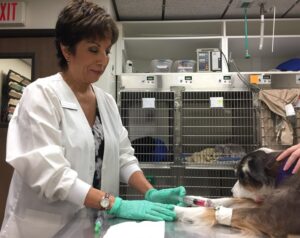
Dr. Bernadine Cruz administering intravenous stem cells to Nikita
