Archive for January, 2026

Jan 30, 2026

VetStem Cell Therapy Helps Agility Dog Compete Again

Posted by Bob under Dog Stem Cells

At just one and a half years old, Hex, a Cardigan Welsh Corgi, was already proving herself as a standout in the agility world. In only a few short months, she advanced rapidly through the Novice, Open, and Excellent levels of AKC agility and was just about ready to start competing against more experienced dogs at the Master level of competition. Then, just one week before her first Master-level competition, Hex came in from the yard limping.

Although initial treatment with NSAIDs provided some relief, Hex continued to show reduced range of motion in her left front leg. Her owner sought out Dr. Sherman Canapp of Canapp Sports Medicine, a board-certified veterinary surgeon internationally recognized for diagnosing and treating complex soft tissue and orthopedic injuries in canine athletes. After a thorough evaluation, he diagnosed Hex with multiple soft tissue injuries in her left shoulder, along with abnormalities in both elbows.

Dr. Canapp recommended arthroscopy of both elbows and the left shoulder, followed by VetStem Cell Therapy to support healing and recovery. After completing the surgical repairs and subsequent stem cell injections, Hex began a carefully structured rehabilitation program with a veterinary physical therapist. About three months later, she was cleared to return to agility training.

Her owner reported, “I am grateful and excited to report that Hex is back running agility at the highest levels! One year after her injury, we returned to agility competition. We took things slowly, but she has never looked back – running better than before with a visible improvement in her jumping form and in her performance of the obstacles. Agility is a tough sport and can be even harder for dogs (like Corgis) that aren’t really built for lots of jumping or running up and down A-frames at high speed, but with careful strength and fitness training and stem cells from VetStem, Hex is holding her own competitively, trialing almost every weekend. Hex completed her Master Agility Champion title (MACH) and she will be competing in the AKC Agility Invitational. Most importantly, though, Hex is happy and sound. I know that VetStem Cell Therapy has been a critical part of Hex’s return to sport and I sleep better at night knowing that Hex’s stem cells are banked and ready should we need to use them in the future.”

Stem cells are regenerative cells that can differentiate into many tissue types and release growth factors and proteins that help reduce inflammation, stimulate tissue repair, and promote healing. VetStem Cell Therapy has been used in the treatment of orthopedic injuries, arthritis, and tendon and ligament damage in dogs, cats, and horses. By helping injured animals heal, stem cells can improve quality of life and, in many cases, allow canine athletes like Hex to return to competition.

Whether your dog is a competitive athlete or a beloved companion, VetStem Cell Therapy may help with a variety of conditions and injuries. Speak with your veterinarian or contact us to find a VetStem provider near you.

Hex


Share
Jan 23, 2026

One Health Awareness Month: From Pets to People

One Health Awareness Month is the perfect time to reflect on the connection between animal and human health. Treating animals can lead to breakthroughs for people, which is exactly what happened with VetStem and our sister company, Personalized Stem Cells (PSC). For more than two decades, VetStem has led the way in regenerative medicine for animals, pioneering the use of a patient’s own stem cells to support healing, reduce inflammation, and improve quality of life. Along the way, the success we saw in veterinary patients led directly to the formation of PSC, which now brings the same personalized, cell-based approach to people.

This One Health connection is especially clear in the story of Erin Taormino. Erin is one of the world’s most accomplished trainers of reined cow horses. She became the first woman ever to win the World’s Greatest Horseman title, and in 2024 she joined the NRCHA Million Dollar Rider club, cementing her place in the history of the sport. But years of riding, training, and competing at the highest level took a toll. Erin developed severe osteoarthritis in both hips, leaving her facing the very real prospect of double hip surgery, a procedure that could sideline her career and limit her ability to ride, train, and compete.

Fortunately for Erin, she was already familiar with stem cell therapy, having seen her horses benefit from VetStem Cell Therapy. She stated, “I’ve seen firsthand how stem cells helped my horses recover and perform. When it came to my own body, I wanted to see if there was a way to avoid surgery and stay in the saddle.” Following PSC’s Right-to-Try pathway, Erin received injections with her own stem cells into each hip. After treatment, Erin was able to avoid hip replacement and continue competing at the highest level of her sport, including again this year entering and placing in the Run for a Million competition in Las Vegas, Nevada. She stated, “Stem cells allowed me to keep riding, training, and doing what I love. I don’t know if I’d be here today, competing at this level, if I had gone through double hip surgery. For me, it’s incredible that the same science helping my horses could also help me. We’re both athletes, and stem cells have been a game-changer.”

Erin’s story is a powerful example of how advancements in veterinary medicine can translate into meaningful breakthroughs for people. One Health Awareness Month is a reminder that progress in veterinary medicine can reach far beyond animals. At VetStem, we’re proud that our experience caring for animals has helped shape the future of regenerative medicine for humans too.

Photography Credit: Carolyn Simancik: instagram.com/carolyn_simancik
instagram.com/taorminoperformancehorses

Share
Jan 16, 2026

How Walking Your Dog Supports Joint Health

Posted by Bob under Exercise For Pets

January is Walk Your Dog Month, a perfect reminder that one of the simplest activities you can do with your dog is also one of the most beneficial, especially for their joints. Regular, controlled walks help keep joints healthy and may actually reduce the symptoms or delay the onset of osteoarthritis (OA). Read on to learn how you can keep your dog feeling and moving their best.

You may already know that nearly 1 in 5 dogs will be diagnosed with OA during their lifetime. That’s why prioritizing joint care from an early age is so important. While there are many ways to support canine joint health, research shows that consistent, low-impact exercise, like daily walks, can help maintain joint function and mobility in dogs both with and without OA.

Walking plays a key role in maintaining joint health by promoting the circulation of joint fluid, which helps nourish cartilage and keep joints moving smoothly. Regular walks also support healthy weight management, reducing excess stress on joints that can accelerate wear and tear. In addition, walking strengthens the muscles surrounding the joints, improving stability and helping protect against injury and long-term degeneration.

When it comes to exercise, consistency matters more than intensity. Dogs who are mostly sedentary during the week and then pushed into long, strenuous activities on the weekend are at higher risk for joint strain, soreness, and injury. Sudden bursts of activity can overload joints and soft tissues that aren’t conditioned for the demand. Daily walks, even if they’re shorter, provide steady, low-impact exercise that helps dogs build and maintain strength safely over time.

All of that being said, walking is not a foolproof method for stopping or curing OA altogether. Your veterinarian can offer advice in terms of supplements and other ways to support your dog’s joint health. Additionally, VetStem Cell Therapy has been shown to reduce pain and lameness associated with arthritis in dogs, thereby leading to a better quality of life.

Share
Jan 9, 2026

VetStem Cell Therapy for Aussie with Sebaceous Adenitis

Today, January 9th, is National Australian Shepherd Day and we wanted to share the story of a special Aussie who was treated with VetStem Cell Therapy for a non-standard indication: sebaceous adenitis. We haven’t discussed this topic much on our blog however a few patients have received VetStem Cell Therapy for this condition and have experienced good results overall.

Sebaceous Adenitis

Sebaceous adenitis is a challenging immune mediated skin disease in dogs in which the immune system attacks the sebaceous glands. These glands help to maintain skin and coat health. Dogs with this disease often experience dry and brittle fur, hair loss, scaling, skin lesions, and potentially secondary skin infections.

Unfortunately, like most immune mediated conditions, treatment is aimed at controlling symptoms and is not curative. This means that lifelong treatments such as frequent bathing with medicated shampoos, along with supplements and medications will be necessary to help keep pets with this disease comfortable. As you can imagine, treatment can be labor intensive and not all pets respond.

Nikita’s Story

Nikita, an Australian Shepherd, was diagnosed with sebaceous adenitis after her owner noticed patchy fur with poor skin and coat quality. Nikita’s case was so bad that she was on heavy doses of steroids and other immunosuppressive medication. Her dedicated owner sought treatment with stem cell therapy, hoping to achieve a better quality of life for Nikita.

Nikita’s initial treatment included three separate intravenous doses spaced approximately one week apart. After her first two doses, both her veterinarian and her owner noticed slight improvement in her skin. Approximately thirty days after her initial treatment, her owner noticed that her fur was growing back, her skin was healthy, and she was off 75% of her medication. Nikita was also more social and willing to play again. It was clear she was feeling much better!

Following Nikita’s initial stem cell treatment, she continued to receive retreatments once to twice a year to help keep her symptoms under control. Prior to stem cell therapy, her condition had progressively worsened, and her owner shared that the disease was slowly but surely taking her life. One family member recalled, “Unless you had seen Nikita so close to dying, you can’t appreciate what a gift stem cells have been. She is such a happy, naughty, loving, and lovable little dog now.”

Stem Cells for Immune Mediated Diseases

While stem cells are still being studied for the treatment of immune mediated diseases, we do know that stem cells play a key role in not only managing pain but also in down-regulating inflammation. Perhaps most importantly for these conditions, stem cells have demonstrated immunomodulatory characteristics and the ability to help balance a patient’s immune system.  By addressing immune imbalance rather than solely managing symptoms, stem cell therapy may serve as a valuable treatment for dogs with sebaceous adenitis, particularly those that are difficult to manage with conventional therapies alone.

The Takeaway

Though stem cell therapy did not cure Nikita’s disease, it played a meaningful role in improving her comfort and overall quality of life. VetStem Cell Therapy is not the answer for every condition and may not help every patient the way it helped Nikita. That being said, if your pet is struggling with an immune mediated disease that is not well controlled by standard treatment, speak to your vet about stem cell therapy. Or reach out to us for more information and a list of VetStem providers in your area.

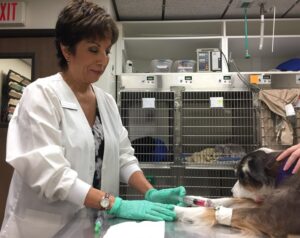
Dr. Bernadine Cruz administering intravenous stem cells to Nikita

Share